- Published on:
- Published on:
- Last Update:
- Last Update:
Power and Electricity in Panama 2026
Panama electricity at 110V/60Hz with US plugs, plus what power costs per kWh and bill tips for 2026.
On this Page

Introduction
Quick answer: Panama uses 110V / 60Hz with US-style plugs (Type A/B).
Most travelers from the US/Canada don’t need an adapter. EU/UK/AU visitors usually need a plug adapter, and sometimes a voltage converter for high-power appliances.
| Topic | Quick answer |
|---|---|
| Standard voltage | 110V (often ~120V in practice) |
| Frequency | 60 Hz |
| Plug types | Type A / Type B (same as US) |
| Do you need an adapter? | US/CA: usually no · EU/UK/AU: yes (plug adapter) |
| Do you need a converter? | Only for non–dual-voltage devices (common with some hair tools) |
| Power outages? | Possible (storms/works). Keep a power bank + surge protection. |
What voltage and frequency does Panama use?
Panama runs on 110V (often around 120V) and 60Hz.
That’s great news if you’re coming from the US or Canada—your chargers and most everyday electronics will work normally.
If you’re from many parts of Europe, your devices may support 110–240V (dual voltage), but you’ll still need the right plug adapter.
What plug type is used in Panama?
Panama uses Type A and Type B plugs (the classic US two-flat-pin plugs, with or without the third grounding pin).
Hotels, apartments, and modern buildings typically have Type B outlets (with ground).
Do I need a plug adapter in Panama?
- No if your plugs are US/Canada Type A/B.
- Yes if you’re from Europe/UK/Australia (your plug shape won’t fit).
A plug adapter is cheap and solves 80% of problems.
Do I need a voltage converter in Panama?
Only if your device is not dual-voltage.
Check your charger label:
- If it says “Input: 100–240V” → you do NOT need a converter (just a plug adapter).
- If it says “Input: 220–240V only” → you may need a converter (or use a different device).
High-power appliances (some hair dryers, straighteners, kitchen gadgets) are the usual trap.
Can I use EU/UK appliances in Panama?
Often yes for chargers (laptops/phones) because many are 100–240V.
But for heating devices (hair tools, kettles), it depends—many EU models are 220V-only and will perform badly or fail on 110V without a proper converter.
Are power outages common in Panama?
Outages aren’t “daily life” in most city areas, but they do happen—especially during heavy rain, storms, or maintenance work.
If you work online, treat this like a predictable inconvenience:
- keep a power bank for your phone
- consider a small UPS for your router
- use a surge protector for your laptop/desktop
Electricity safety tips for apartments and long stays
If you’re staying longer (or renting), do these three things:
- Use a surge protector (power quality can vary)
- Don’t overload one outlet with multiple high-power devices
- Ask if the building has a backup generator (some do, especially newer towers)
How to reduce your electricity bill in Panama
Your biggest bill drivers are almost always:
- A/C usage
- water heater
- leaving devices running 24/7
Quick wins:
- Set A/C to a realistic temperature and use fans to feel cooler
- Turn off the water heater when not needed (if it’s not automatic)
- Unplug chargers/power strips when traveling
What should I pack for power and electricity in Panama? (Travel checklist)
- 1 plug adapter (if you’re not US/CA)
- power bank (at least one full phone recharge)
- surge protector (small travel one)
- optional: small UPS if you rely on Wi-Fi for work
Electricity Market in Panama
Generation
The generation of power represents the first part of the process, where in Panama many private companies produce electrical energy for sale.
Transmission
After the generation the electricity must be transmitted to the distribution companies or Large Customers. The Transmission is in charge of the only transmission company in the Panamanian electricity market, the Electric Transmission Company, S. A. (ETESA), 100% owned by the state.
Distribution
Three main companies are responsible for the distribution and marketing of electrical energy: ENSA, Edemet and Edechi, the last two are part of the Naturgy group. ENSA distributes electricity to users in Colón, Darién, the Kuna Yala Region, Eastern Panama, and the Pacific Islands. Naturgy distributes energy to West Panamá, Coclé, Herrera, Los Santos and Veraguas, Chiriquí and Bocas del Toro
Cost of Electricity
In Panama, the average cost in 2023 of residential electricity is around $0,170 per kWh while the cost for businesses is around $0,185 per kWh. This includes all components of the electricity bill such as the cost of power generation, distribution and taxes. If we compare the price with the rest of the world, the cost is slightly higher compared to the average price of electricity in the world and similar to the US. The cost of electricity bills can vary between the different neighbourhoods in Panama City, thanks to the subsidy that the government guarantees in the various parts of the city. This results in a monthly bill for electricity between $100 and $300, depending on the size of your home.
Sources of electricity generation
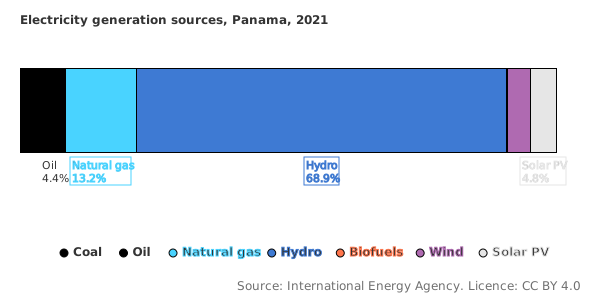
According to the latest data from the International Energy Agency in 2021, the electricity generation sources are Hydro at 68,9%, followed by Natural Gas at 13,2%, Solar PV at 4,8%, Wind and Oil at 4,4%, and finally Coal at 4,1%. The Total electricity production in Panama 2021, is 12106 GWh, the 99th country in the world by electricity production.
Share of renewables in energy consumption
Renewable energies are becoming an increasingly relevant source of energy for countries, as they can reduce CO2 emissions and dependence on imported fossil fuels. According to the latest data from the International Energy Agency, Panama's share of modern renewables in final energy consumption is 22,73% in 2020, placing it in 40th place among countries in the world.
Electricity final consumption by sector
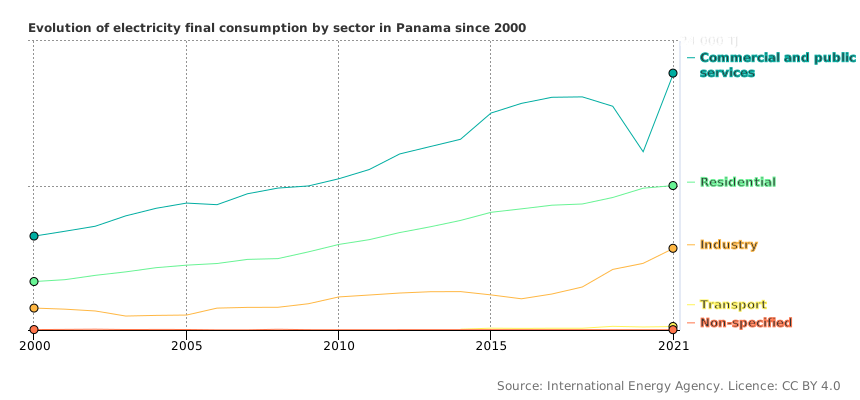
Studying the electricity final consumption by sector, we can find that the commercial and public services are the first consumers with a share of 52,8% in 2021, followed by the residential sector at 29,7%, and the Industry sector at 16,8%. These data are correlated to the GDP produced by the sector in the economy of Panama.
FAQ — Power & electricity in Panama
Does Panama use 110V or 220V?
Panama uses 110V (often ~120V) at 60Hz.
What plug type is used in Panama?
Mostly Type A and Type B (US-style plugs).
Do US travelers need an adapter in Panama?
Usually no. US/Canada plugs fit.
Do Europeans need an adapter in Panama?
Yes—most EU/UK plugs won’t fit Type A/B outlets, so you need a plug adapter.
Do I need a voltage converter in Panama?
Only if your device is not dual-voltage. If your charger says 100–240V, you’re fine with just an adapter.
Are power outages frequent in Panama?
They can happen, especially during storms or maintenance. A power bank and surge protection make life easier.
Will my hair dryer work in Panama?
Maybe. Many are 220V-only and won’t work well on 110V without a converter. Check the label for 100–240V support.
Sources & Foot Notes
[1] Statista - Price of Residential Electricity in Panama
[2] Enerdata - Energy Market in Panama
[3] International Energy Agency - Panama
[4] Global Petrol Prices - Electricity Prices in Panama
[5] Enel Green Power - Fortuna Hydroelectric Plant
[6] Database Earth - Hydro Power Plants in Panama
[7] IEA - Renewables in the Energy Mix of Panama
[8] Panama National Energy Plan 2015–2050
Guides on this website might contain affiliate links. When you click those links and buy something, we make a little money. This allows us to work on this website full time.